

Wet Wood

The cast iron door creaks. A deep “whoosh” as air is pulled through the flue. A rustle as a fresh log is placed on the embers of yesterday’s fire. The door closes, silent this time.
A minute or so of stillness, a crackle, and the first few tendrils of flame begin to envelop the wood.
I sink a little deeper into my seat.
Will we ever lose our love of fire?
Much of the work here was done ahead of time. The wood seasoned for years. The kindling tended and fiddled with when it wasn’t catching: not as dry as expected.
We could have used firelighters. But where’s the fun in that?
We play with the air vent, much like tuning a guitar string. Get overly ambitious and suffocate the fire with too large a log. Eventually, after the initial awkwardness, we’re rewarded with a strong, roaring flame.
A few more hours, and we have a red-hot heart - able to light any but the wettest of logs.
But this piece isn't about fires, is it, dear reader? You could likely sense there was a pivot coming. An ulterior motive. And lo - it hath arrived!
I got this message from a client a little while back.
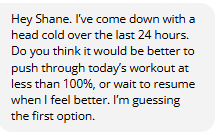
He’s clearly listened well on our calls.
Now, I’m not a monster. “Push through anyway” isn’t exactly what I advised. I suggested shaving off a rep or two here and there. Possibly even a couple of sets if he felt truly shagged. But that he should absolutely do the session.
A slightly damp log will still burn, but it’s best to start small and be willing to take it off if all you’re getting is smoke.
Worst case, the pressure behind his eyes gets worse as the workout goes on, he thinks I’m a bit of an arsehole, and has to cut it short. Still having done more than nothing, mind you.
More likely, after a sluggish warm-up, he gets into the groove and feels better, perhaps even slightly smug, for having ventured beyond the stuffy confines of his home.
“But what’s the problem in one missed session?” you might say. “You don’t lose your progress in such a short amount of time.” Quite right. But my concern here is not with the body. It is with the mind.
What precedent does it set, if at the first sign of resistance, we withdraw?
We may claim it an act of kindness to opt out of such commitments when we’re sick. Or sleepy. Or busy. Or when the dog has taken a shit on the carpet. But where is the kindness in sliding back into the cold that prompted you to light the fire in the first place?
Was that not the more potent pain?
This man skips a session due to a sore throat. Then what? He gets stuck in traffic on the way home from work and misses another session. Then his knee is nagging him, and he’s kind of tired anyway, and it’s almost the weekend, so fuck it - he’ll just come back stronger on Monday.
We know how this ends. His bed is too warm come his morning alarm. If he turns his leg at the wrong angle, he swears he can still feel that niggle in his knee. Best give it a couple more days. Another week or two. And he's back to cold ash and kindling.
The early phases of training - or any lifestyle change for that matter - are the most fragile. They require the most care and attention, to ensure the flame is neither suffocated, nor left to starve.
Sometimes the wood is wet. You can't treat a damp log the way you would a dry one.
If you take this Goggin’s approach to fitness and forge grimly onward in spite of any resistance you face, you'll suffocate the fire with sodden logs.
You'll begin to loathe the process. You'll question if it's truly worth the pain, perhaps berate yourself for not being "strong enough," and inevitably give up.
But to feed the fire with nothing is to wilfully see it wither and die. From there, who knows how long it will be before you deign to start the whole process anew?
No, best to keep the fire burning. In whatever capacity possible.
By, the by - I run a 5-Week Incubator to tackle this very problem.
By which I mean abandoning attempts to get in shape before they get past the fragile early stages… not starting actual fires.
If you’d like to hear more, fill out this brief form.
As a younger man, I'm still pretty damn young, I used to battle through anything that wasn't body aches or vomiting. My thinking was, if I can stand, I can lift and move.
And I would usually push it even harder, as if in defiance of the virus.
Over fifty now—and I have many years to state it that way—I measure HRV and recovery like a nerd. I pay close attention to the nuance of fatigue, and more often land on the side of taking it easy when I'm sure it's a virus.
But I never derail the habit. I don't skip the ritual of getting ready and going to the gym. (Thankfully, ours is private, not shared, so I risk infecting nobody.) Unless I'm flat on my back, which is rare, I put on my shoes and move.
Back in 2024, my neurologist was concerned when I told him I was in the gym the day after my cervical surgery. Then I explained to him that I mostly just went there. I got on the floor, opened up my hips, tested some positions, and walked around a lot.
I think this is the hardest part about a movement practice, beyond carving the habit. It's less about the knowledge of proper movement technique, which is definitely important, and more about knowing our bodies in ways we never imagined we could. The brain (part of said body) is the toughest part to sort out. It's not one thing, and all those arising parts (patterns) can feel tricky.